The Delightful Return of the Seahorse to the South West Coast
NEWS from Plymouth, Devon - Seahorse Conservation
30th August 2025
The shimmering waters of the South West coast are witnessing a wonderful homecoming. Thanks to dedicated marine conservation efforts, seahorse populations are flourishing, returning to the vital seagrass meadows stretching all the way from Exmouth to Plymouth and beyond.

The Short-snouted Seahorse by Neil Parker
For those of us lucky enough to live near the Devon coast, this area has always been known as a prime habitat for these magical creatures. Now, both of the UK's native species are making a strong reappearance: the Spiny Seahorse (Hippocampus guttulatus) and the Short-Snouted Seahorse (Hippocampus hippocampus). Fun fact: their scientific name 'Hippocampus' comes from a Greek term meaning "Horse Caterpillar".
The Seahorse Trust has confirmed both species can be found from Exmouth right down to Paignton. They love the local eelgrass beds and often live remarkably close to shore, sometimes only 100 to 200 yards off the beach!
A Tale of Two Species and Their Hidden Habitats
While you might associate seahorses with tropical climates, they are found in British waters from the Shetland Islands down to Ireland, and particularly along the coasts of Devon and Cornwall. They are less common, but can also be found, on the East coast in the North Sea.
This recent comeback in places like Plymouth Sound and the restored meadows of Carbis Bay in Cornwall is a direct result of focused action in replanting the essential seagrass beds.
Seagrass meadows are absolutely crucial. They serve as nursery habitats for countless marine species, including our fascinating seahorses. The Ocean Conservation Trust in Plymouth has been instrumental in raising awareness of the vital role these meadows play, not just as a home for wildlife, but also in tackling climate change.
The Unsung Carbon Heroes of the Ocean
Did you know that seagrass meadows are powerful carbon sinks? They can absorb an astonishing 35 times more carbon than forests!
The scale of the restoration work is impressive. Back in 2020, dedicated volunteer divers collected 700,000 seagrass seeds. These were cultivated and successfully replanted into Plymouth Sound, leading to the regeneration of seagrass in the Sound and, happily, encouraging the seahorses to return.
One of the seagrass residents is the Long-snouted Seahorse (another name for the Spiny Seahorse). This small fish only grows to about 12cm, and you can spot it by the fleshy, mane-like protuberances on its neck and back.
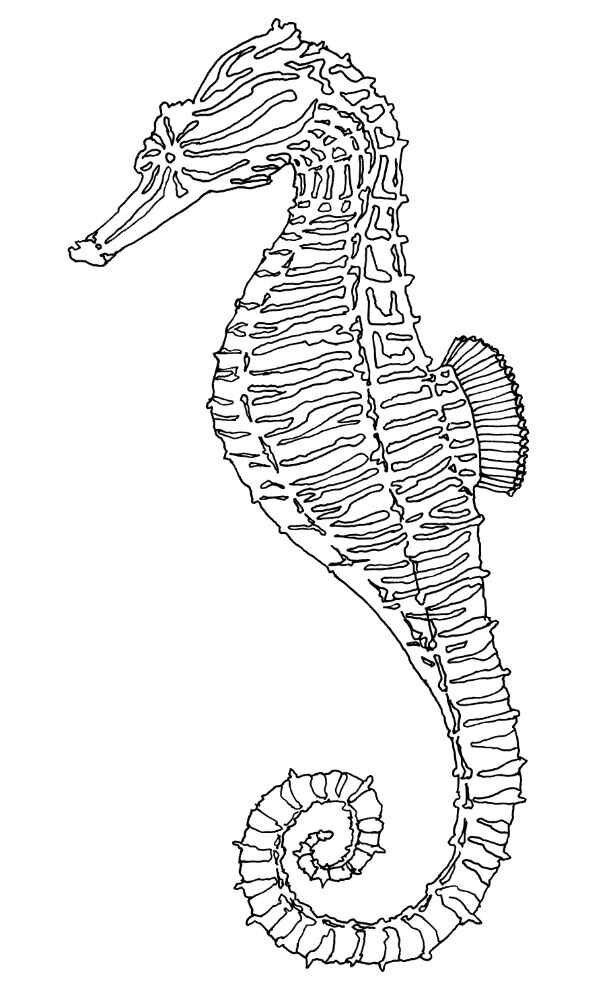
The Extraordinary Anatomy of a Seahorse
These creatures are full of surprises:
The Vacuum Snout: What looks like a nose is actually an elongated snout, vital for survival. The seahorse uses it like a tiny vacuum cleaner to suck up food from seaweed, rocks, and sand. Remarkably, they can expand it to consume larger food items. Unlike other animals, they don't chew and must break up their food as they ingest it.
The Anchor Tail: Seahorses aren't great swimmers, so their unique, curled, prehensile tail is essential for stability. They use it to firmly grasp seagrass and seaweed, anchoring themselves against strong currents.
A Life of Colour and Appetite
The seahorse's diet consists mainly of small crustaceans, such as shrimps. Adult seahorses have a significant appetite, feeding between 30 and 50 times daily. Baby seahorses, or fry, are even more voracious, potentially eating up to 3,000 pieces of food in a single day to fuel their rapid growth!
One of their most remarkable adaptations is their ability to change colour for camouflage, blending seamlessly with their surroundings. The Seahorse Trust has even observed this during their complex courting rituals: breeding pairs, who bond for a season or a few months, will change colour as they meet for their early morning rituals.
Whatever it is, the way you tell your story online can make all the difference.
The Phenomenon of Reverse Pregnancy
Perhaps the most fascinating fact is their unique reproduction. The male seahorse undergoes a true reversed pregnancy! The female transfers her eggs into the male's pouch, where he then self-fertilises them.
Smaller species can produce 50 to 150 eggs, while larger species may lay up to 1,500. The male provides the developing eggs with essential nourishment and oxygen for a two to four-week gestation period. The birth itself is an epic event, following a prolonged period of contractions that can last up to 12 hours.
Interestingly, adult seahorses don't travel widely, maintaining a small territory. The female's territory is about 100 square metres, while the male's is much smaller, roughly half a square metre. However, the newly born seahorse fry are not looked after by their parents; instead, they drift in the ocean's plankton layer for their first few weeks of life.
The Global Threats and Local Solutions
Despite their local success, seahorses face significant global threats:
The traditional Chinese medicine trade consumes an estimated 150 million wild seahorses annually.
The souvenir trade cruelly harvests and sun-dries approximately one million seahorses from the wild.
The pet trade takes up to one million seahorses, sadly, many of whom perish within weeks.
Restoring the South West's Underwater Gardens
The Plymouth Sound Special Area of Conservation (SAC) is a hotspot for restoration. The Ocean Conservation Trust is the lead UK partner in the LIFE Recreation ReMEDIES project, a £2.5 million marine conservation partnership.

Image Credit: Mark Parry, Ocean Conservation Trust
The team has been trialling two key restoration techniques:
Seed Broadcasting: Restoring 3.4 hectares of seagrass by deploying seeded hessian bags using an innovative injection device called HMS OCToPUS (Ocean Conservation Trust Pressurised Underwater Seeder).
Seedling Translocation: Restoring 1.18 hectares using live plants grown from seed in a laboratory at the National Marine Aquarium in Plymouth, where each live mat contains an average of 35 plants.
Taking innovation even further, engineers at Reefgen have developed the 'Grasshopper' robotic seagrass planting device. CEO Chris Oakes calls it an 'underwater tractor' that can plant seagrass far faster and cheaper than manual diving and planting. This Reefgen technology is even going global, with plans to plant 300m2 of seagrass in Puget Sound, USA, in partnership with the high-speed sailing league, SailGP. Plymouth can be truly proud of its maritime success in both sailing sport and seagrass protection.
In 2020, the Ocean Conservation Trust began work to restore 8 hectares of seagrass in Jennycliff Bay near Plymouth, an area about the size of eleven football pitches! The positive results are clear, showing regenerated seagrass beds and the happy return of the seahorses.
The continued success in protecting our ocean meadows relies on global conservation and supporting organisations like The Ocean Conservation Trust. By working together, we can ensure a future where these unique and fascinating creatures continue to thrive along our stunning coastline.
Articles like this are written in Old English and published in The Boat Cove Chronicle printed newspaper.

FREE Postage & Packaging Included - Issue 1 of The Boat Cove Chronicle or The Illustrated Mariner’s Gazetteer.
£5.00 + FREE Shipping (postage & packaging costs included)
A maritime newspaper that captures the feeling of receiving news in 1750, arriving by the wind and tide, carried on the backs of weary travellers and the sails of grand ships.
Today’s maritime news stories and researched articles are written in 18th-century Old English.
Evocative printed illustrations and maps by Neil (Nelly) Parker, hand-drawn in an 18th-century style.
Printed on genuine newsprint paper.
Printed on two 18th-century style large-format 18-inch sheets.
Bibliography
LIFE Programme (n.d.) EU’s funding instrument for the environment and climate action. Available at: https://cinea.ec.europa.eu/programmes/life_en (Accessed: 1 June 2025).
The Green Blue (n.d.) Sustainable Boating for Cleaner, Healthier Waters. Available at: https://thegreenblue.org.uk/ (Accessed: 2 June 2025).
The Marine Life Information Network (n.d.) Common eelgrass (Zostera subg. Zostera marina). Edited by H. Tyler-Walters and L. Jones. Available at: https://www.marlin.ac.uk/species/detail/1282 (Accessed: 2 June 2025).
Natural England (n.d.) Available at: https://saveourseabed.co.uk/the-project/partners-funders/natural-england/ (Accessed: 1 June 2025).
The Ocean Conservation Trust (2021) Rare Seahorse Spotted in South West. Published 10 June 2021. Available at: https://oceanconservationtrust.org/rare-seahorse-encounter-in-south-west-ahead-of-g7-summit/ (Accessed: 2 June 2025).
The Ocean Conservation Trust (2024a) An innovative device to restore seagrass meadows. Published 8 October 2024. Available at: https://oceanconservationtrust.org/an-innovative-device-to-restore-seagrass-meadows/ (Accessed: 2 June 2025).
The Ocean Conservation Trust (2024b) Seagrass Mat Technology. Published 5 July 2024. Available at: https://oceanconservationtrust.org/englands-largest-seagrass-restoration-effort-continues/ (Accessed: 8 October 2024).
The Ocean Conservation Trust (2024c) The Ocean Conservation Trust Seagrass Project. Published 1 November 2024. Available at: https://oceanconservationtrust.org/success-for-englands-largest-seagrass-restoration-project/ (Accessed: 2 June 2025).
Reefgen (n.d.) Reefgen Grasshopper Robot Seagrass Planter. Available at: https://www.reefgen.io/ (Accessed: 2 June 2025).
Royal Yachting Association (RYA) (n.d.) Available at: https://www.rya.org.uk/ (Accessed: 2 June 2025).
SailGP (n.d.) Ocean Impact Project, Emirates and SailGP visited the Reefgen team. Available at: https://sailgp.com/news/25/sailgp-ocean-impact-project-funds-underwater-seagrass-robot (Accessed: 2 June 2025).
Save Our Seahorses. ReMEDIES (n.d.) EU Life Funding. Available at: https://saveourseabed.co.uk/the-project/partners-funders/eu-life-funding/ (Accessed: 2 June 2025).
The Seahorse Trust (n.d.) Seahorse Facts. Available at: https://www.theseahorsetrust.org/seahorse-facts/ (Accessed: 2 June 2025).
Tamar Estuaries Consultative Forum (n.d.) Available at: https://www.plymouth-mpa.uk/tamar-estuaries-consultative-forum (Accessed: 2 June 2025).
The Zoological Society London (n.d.) Project Seahorse. Available at: https://www.zsl.org/what-we-do/projects/project-seahorse (Accessed: 2 June 2025).
